The reporting inside Meta Ads Manager has always been the primary tool dental practices use to judge whether their paid social spend is working. Cost per lead, lead volume, engagement rate. These numbers have driven budget decisions for the better part of a decade. Andromeda changed enough about how Meta delivers ads that several of those numbers now tell a different story than they used to, and reading them the old way is producing bad calls in accounts that are actually performing well.
The core issue is not that Meta broke. The delivery system got better at routing spend toward impressions and interactions that produce bookings, but many of those bookings now arrive through channels other than a direct Meta lead form. The report a practice reads inside Ads Manager is still accurate about what happened inside Ads Manager. It is no longer a full account of what the channel produced.
What the Top-Line Numbers Now Overweight
Cost per lead was, for most of the last decade, the single most useful number in a dental Meta account. It compressed audience quality, creative performance, and offer strength into one figure. If it moved up, something needed attention. If it moved down, something was working.
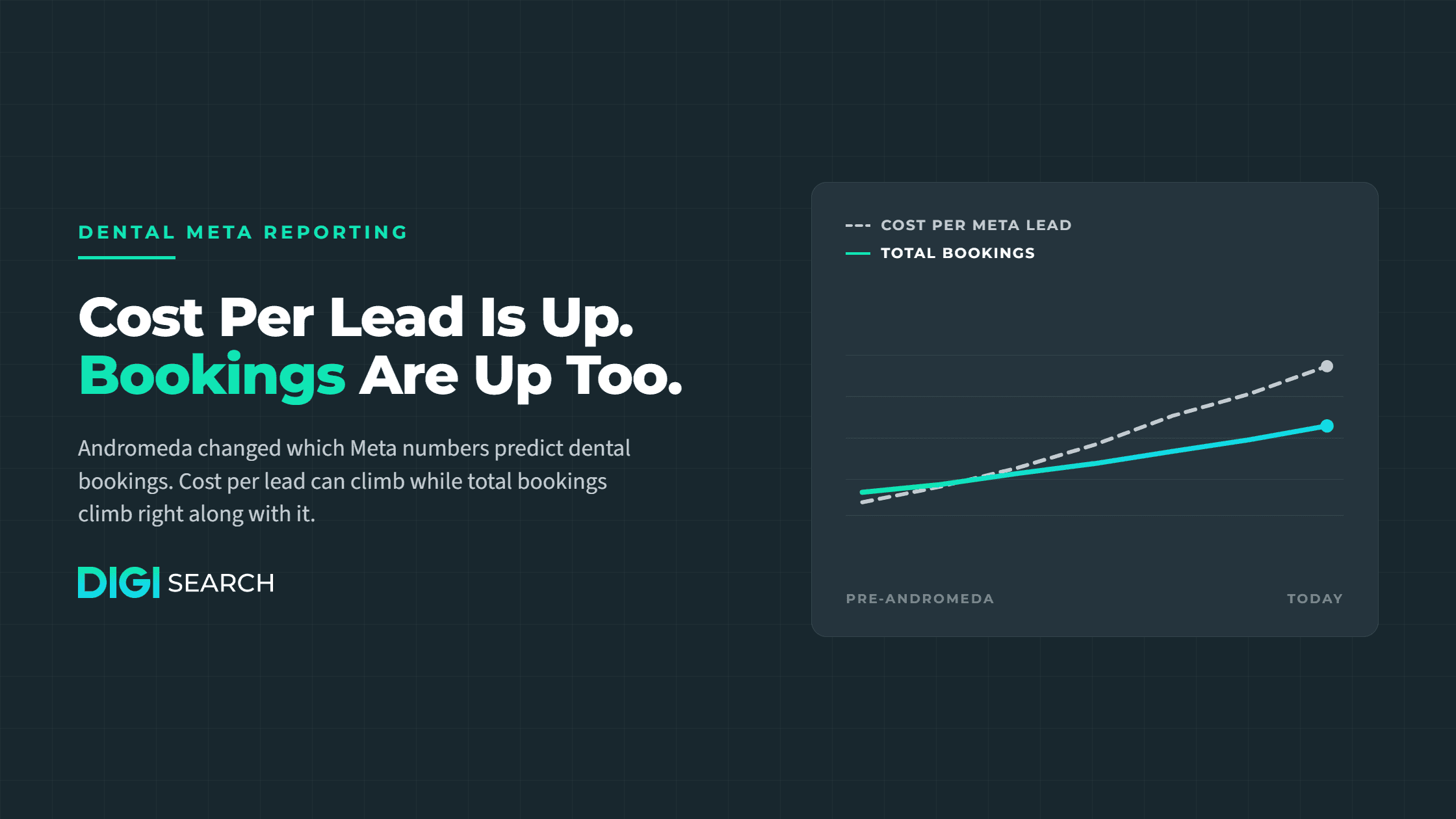
Andromeda broke part of that compression. The delivery system now routes more spend toward impressions and interactions that do not produce a direct Meta lead but do produce a downstream booking through another channel. Cost per direct Meta lead can climb even when total practice bookings climb alongside it, because the direct-lead denominator has shrunk as a share of what the channel actually generates.
Those dollars are still working. They are producing recognition that Meta’s own report does not have a column for.
The Delayed-Conversion Pattern
A patient sees a dental practice on Instagram or Facebook. They do not click the ad. They do not fill out a form. They keep scrolling. Two weeks later, they mention to a family member that they need a new dentist. The family member does not have a recommendation. The patient opens Google, types the practice name they half-remember, and books.
That path shows up in Google Business Profile inquiries, in branded organic search volume, in “How did you hear about us?” answers at the front desk when someone asks and logs the answer, and in the monthly booking total. It does not show up in Meta Ads Manager as a lead. A practice reading only the Meta report concludes Meta is underperforming. A practice reading the cross-channel picture sees Meta doing exactly the job a hybrid awareness-and-interest channel is supposed to do.
The Metrics That Now Matter Most
Adjusting the read on a dental Meta account after Andromeda is a matter of moving attention off the metrics that got noisier and onto the metrics that stayed clean.
Still useful and largely unchanged:
- Total new-patient bookings across all channels
- Front-desk answers to the source question, when the practice trains for it and logs it
- Verified Ads™ booking rate and average first-appointment value
More important than before:
- Branded organic search volume, meaning searches for the practice’s actual name
- Google Business Profile inquiries and direct calls
- Time-lag data between first Meta impression and eventual booking, where tracking supports it
Now noisier and worth less in isolation:
- Meta cost per direct lead as a standalone month-over-month comparison
- Meta lead volume viewed alone
- Meta engagement rate as a proxy for downstream performance
For the underlying delivery mechanics behind these shifts, the earlier post on Andromeda’s real impact on healthcare advertising covers the reasoning.
Diagnosing a Real Cost-Per-Lead Spike
Not every rise in cost per Meta lead is a reporting artifact. Some are real problems worth acting on. The way to tell the difference is to look at what happened elsewhere in the same window.
If Meta cost per lead rose, and branded organic search volume rose alongside it, and Google Business Profile inquiries rose alongside it, and total bookings held or increased, the spike is a reporting artifact. The channel is doing more of its work upstream, and the signals of that work are showing up upstream. No corrective action is required. The account is healthy.
If Meta cost per lead rose and none of the other cross-channel signals moved and total bookings dropped, the spike is real. The likely candidates are creative fatigue with variants running past their useful life, a compliance flag suppressing delivery, an offer that stopped resonating, or a competitor entering the market with better creative volume. All of those call for action, and all of them are addressable once the diagnosis is right.
The shape of the whole picture, not any single top-line number, is what tells a practice whether to act.
What This Means for Practice Owners
Practices running Meta inside the SmartReach™ system see the reporting split this way as a matter of course, because the cross-channel funnel view is built into how the budget is managed. Practices running Meta as a standalone channel have to build the cross-channel view themselves. The tools to do it live inside a standard analytics stack. It is not a technical lift. It is a reading lift, and it is worth making.
Cost per Meta lead is up in most dental accounts since Andromeda. Total bookings are also up in most of the same accounts. Both are true, and only one of them should be driving the monthly assessment of whether paid social is working.
Bring these reporting questions to a discovery conversation with the DIGI Search team.