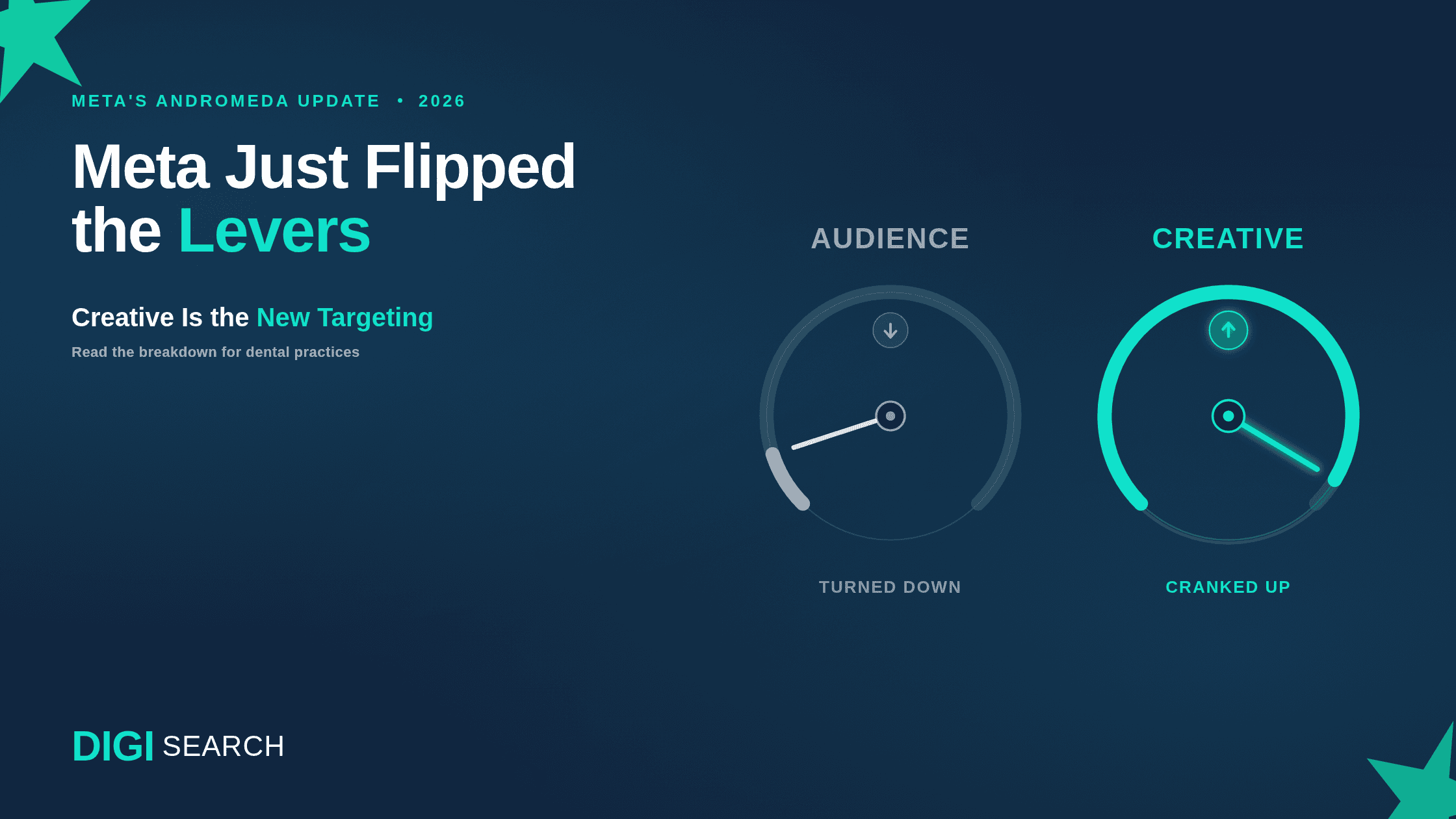
The change Meta made to its advertising system in late 2025 is the most consequential shift Facebook and Instagram have seen in over a decade.
It is called Andromeda, and most dental practices have heard nothing about it, even though it has already changed how their ads reach patients (or fail to).
What Andromeda Actually Is
Meta rolled out Andromeda across most ad objectives by October 2025. The update is not a new ad type, a new campaign setting, or anything visible inside Ads Manager. It is a complete rebuild of how the platform decides which ads to show to which users.
For ten years, advertisers told Meta who to target. The platform routed ads based on demographics, interests, lookalikes, and behavioral signals the advertiser selected. The advertiser drove the targeting decisions.
Andromeda reverses that flow. Meta’s AI now reads the creative (the image, the video, the headline, the copy) and predicts which users are most likely to respond. The advertiser-defined audience has become a suggestion, not a rule. According to Meta, Andromeda is roughly four times more efficient at driving ad performance gains compared to the previous ranking system.
For dental practices, the practical implication is this: the strength of the creative now matters more than the precision of the targeting setup. A strong ad shown to a broad audience will reach more of the right patients than a weak ad shown to a perfectly defined one.
Why This Matters More for Dental Than for Most Industries
Dental practices have always operated under Meta’s special-category restrictions. Ads for healthcare providers cannot target users based on health status, condition, or implied medical attributes. Those restrictions limited the precision targeting that most advertisers built their playbooks around, which made dental advertising harder than ecommerce advertising for years.
Andromeda quietly removes much of that disadvantage. Because Meta’s AI now does the targeting work the platform previously asked advertisers to do, dental practices benefit from the same machine learning that ecommerce brands get. The targeting that used to be off-limits for healthcare advertisers is no longer a manual setting practices need access to. The system handles it.
The translation: dental practices on Meta now operate on a more level playing field than they did before Andromeda. The winners are the ones whose creative output keeps up with what the system can deliver.
What This Means in Daily Practice
Three shifts matter for dental marketing under Andromeda.
Creative volume now drives performance. Meta’s system needs material to evaluate. A practice running two ads will be outperformed by a practice running ten, all things equal. Variety of hooks, angles, and visual approaches matters more than perfecting a single ad. Practices that have been running the same Invisalign creative for a year are leaving performance on the table.
Audience refinement matters less. Older Meta strategy was built on precise audience selection: interest stacks, lookalike percentages, behavioral filters. Under Andromeda, those layers do less work. The creative itself is the targeting signal. Time that used to go into tweaking audience parameters now goes into producing more creative.
Short-term performance fluctuations are normal. Industry observers have noted that practices holding onto audience-heavy setups have seen larger cost fluctuations during the transition than practices that adapted to a creative-first approach. The first 30 to 60 days under the new system can look noisy. The signal becomes clear by quarter two.
What Practices Should Ask a Marketing Partner
Three questions cut through the noise.
First, how many active ad creatives are running in the practice’s Meta account right now? A current SmartReach™ Meta deployment should have variety in rotation, not a single ad or two. SmartReach™ is DIGI Search’s unified methodology for managing a practice’s total ad budget across the full patient purchasing funnel.
Second, how often is the creative refreshed? Weekly to biweekly is the current standard. Quarterly creative refreshes leave performance on the table under Andromeda.
Third, how is Meta performance being measured? Practices that evaluate Meta on last-click cost per lead alone are missing the larger picture. Meta is a hybrid awareness-and-interest channel. Every impression builds brand familiarity, even from patients who do not click. Practices running Meta alongside NextGen TV™ are seeing the compounding benefit of multi-screen brand saturation.
The Larger Pattern
Andromeda is not an isolated update. It is part of a broader shift across every major ad platform. AI is taking over the optimization decisions humans used to make manually. Google has followed a similar path with Performance Max. TikTok has moved in the same direction with Smart Performance Campaigns. The pattern is consistent across the industry.
For dental practices, the implication is clear. The competitive edge in patient acquisition is shifting from technical targeting expertise to creative quality and strategic budget allocation across channels. Practices that lean into stronger creative production, more frequent refreshes, and a partner managing the full SmartReach™ funnel rather than isolated Meta campaigns will pull ahead. Practices holding onto old playbooks will fall behind.
Closing
Andromeda did not make Meta advertising easier. It made it different. The dental practices winning the next 12 months on Facebook and Instagram will be the ones whose marketing partners understood the shift early and adjusted accordingly.
To explore how a SmartReach™ approach to Meta and the full patient acquisition funnel could work for your practice, schedule a discovery call with the DIGI Search team.