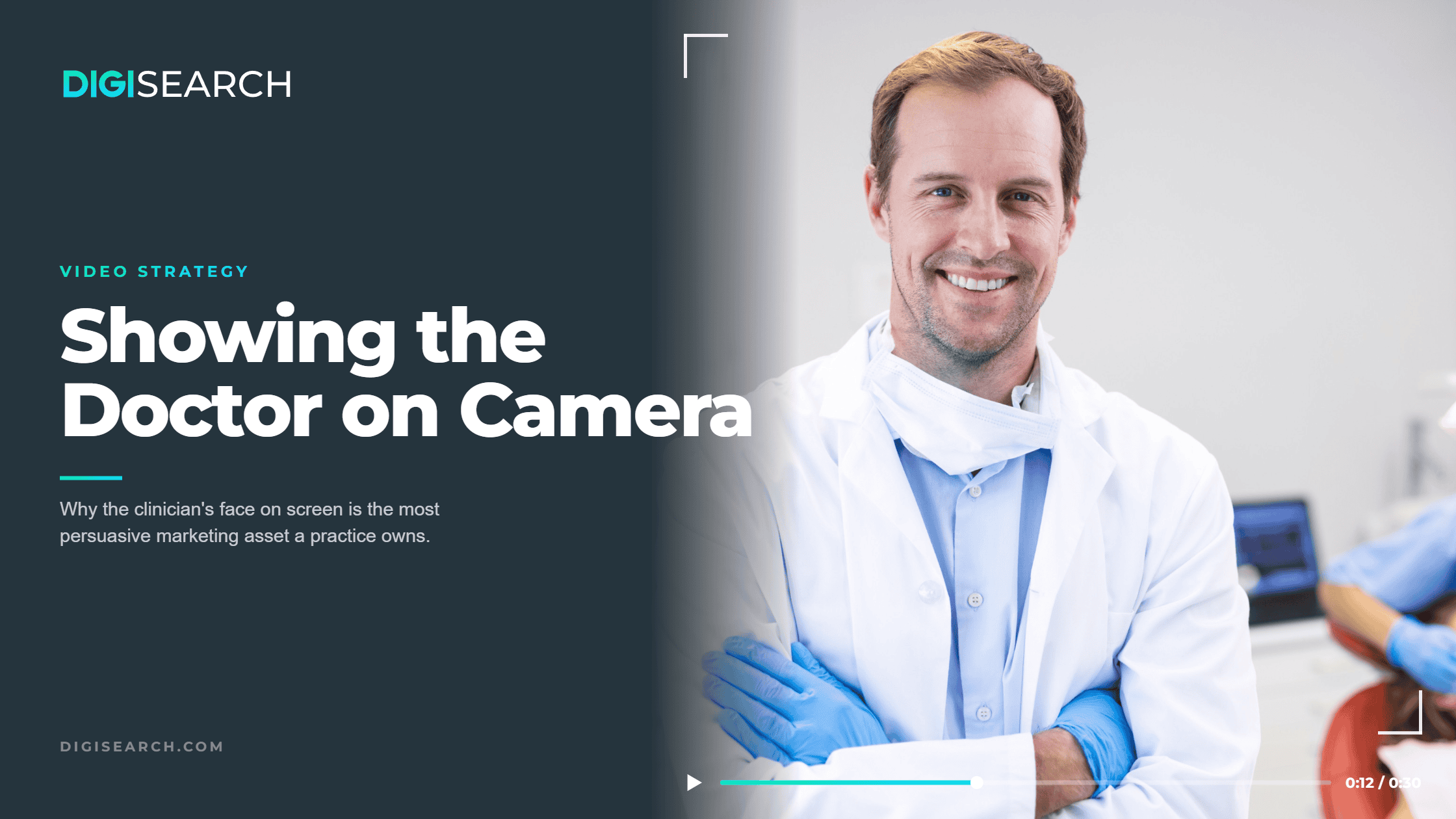
The most persuasive choice in NextGen TV™ creative is putting the actual doctor on camera. Not an actor playing a dentist. Not a voiceover over stock footage of a smiling family. The doctor who will be inside the patient’s mouth, introducing themselves to the neighborhood.
That single choice shapes response rates more than lighting, music, or production budget. It is also the choice most practices avoid, because most doctors have never spent thirty seconds on camera in their lives and it feels uncomfortable to try.
The discomfort is worth pushing through. Here is what the archive of DIGI Search creative shows about what tends to work on screen, and what tends to fall flat.
Why the Doctor Beats the Actor
A patient sitting on a couch in Naperville does not need to see a Hollywood-trained face. They need to see the person they will trust with a crown, an implant consult, or their child’s first cleaning. That is a different kind of persuasion than a movie trailer runs on.
Actors deliver polished lines. Doctors deliver credibility. A viewer scanning between programs on a streaming platform gives a spot about two seconds before deciding whether to keep paying attention. In those two seconds, a hired actor triggers pattern recognition and gets mentally skipped, while a real practitioner sitting in a real operatory breaks that pattern by not looking like an ad.
Recognition builds across impressions. The tenth time a viewer sees the same doctor on the same streaming platform, that face becomes familiar in a way stock footage never manages. When the viewer eventually searches for a dentist, they recognize the name on the Google Business Profile listing. They click with more confidence. This is the mechanism behind the results in The Invisible Engine, where a Naperville practice’s NextGen TV spend fed $213,690 in organic-channel first-year revenue.
NextGen TV Creative That Works
Direct address, not dialogue. The doctor speaks to camera, one person at a time, the way a patient would be spoken to during a consult. Two-actor “conversations” between a hygienist and a receptionist feel scripted within the first sentence.
One idea per spot. A thirty-second NextGen TV commercial can deliver a name, a location, and a single reason to remember the practice. Attempting to list every service produces a spot that says nothing, because a viewer retains nothing.
The operatory, not a set. Practices sometimes assume a studio background reads as competence. Viewers read it as generic. The actual clinical space, with the actual equipment behind the doctor, signals a real place a patient can go.
Slightly slower speech than feels natural. Most first-time on-camera talent races through their lines. A pace that feels slow while filming reads as calm and confident on playback.
Real patient moments only when the consent is real. A brief cutaway of a patient smiling after a consult, when that patient genuinely agreed to appear, adds warmth. A stock-photo patient adds nothing and often subtracts trust.
Where NextGen TV Creative Falls Flat
Reading a script word-for-word telegraphs itself in the first sentence. Viewers watch the eyes, and scripted eyes move differently than conversational eyes. The alternative is to write bullet points rather than sentences, and let the doctor speak from them naturally.
Overproduced settings that look like corporate healthcare stock footage strip away the local, human quality that makes a NextGen TV spot work in the first place. Broadcast-era production values fight against the platform’s strength.
Aggressive promotional offers turn a trust-building impression into a pitch, which is neither the intent of NextGen TV nor consistent with how patients choose a long-term provider. The doctor introducing themselves plainly outperforms the doctor pushing a limited-time offer.
Trying to sound like a national brand commercial produces the least effective creative of all. National toothpaste ads exist to reach millions of strangers with a mass-market product, while a dental practice needs to earn one relationship at a time within a defined neighborhood. The creative approaches should not resemble each other.
The Confidence Problem
Most doctors are self-conscious the first time on camera. That is expected, and it does not need to be solved before filming begins. Two working approaches:
Film multiple short takes rather than attempting a single continuous spot. Thirty seconds broken into three ten-second segments is easier to deliver naturally, and the footage cuts together cleanly in post-production.
Remember what the viewer is actually comparing the doctor to. Not a network anchor. Not an actor. The comparison is to no dentist at all, or to a competing practice that used stock footage. Against those alternatives, a real doctor speaking plainly wins on its face.
What This Costs
NextGen TV bills only on completed views of thirty seconds or more, at approximately two cents per completed view. A practice does not pay for scroll-past impressions or partial views. That billing model means creative that fails to hold attention costs the practice nothing directly, but it wastes the awareness impressions that could have fed downstream channels. The upside of getting the creative right is disproportionate to the effort required to get it right.
A practice evaluating whether the doctor is ready for the camera can start with a simple test: record thirty seconds on a phone, introducing the practice as if speaking to a new patient in the operatory. Watch it back once. If the person on screen looks like someone a neighbor would trust with a filling, the campaign is ready. If not, run the recording again with slower pacing and bullet points instead of a script. The improvement between take one and take three is usually the improvement that separates a spot that performs from one that does not.
See what a NextGen TV campaign looks like for a specific practice on a discovery call with the DIGI Search team.