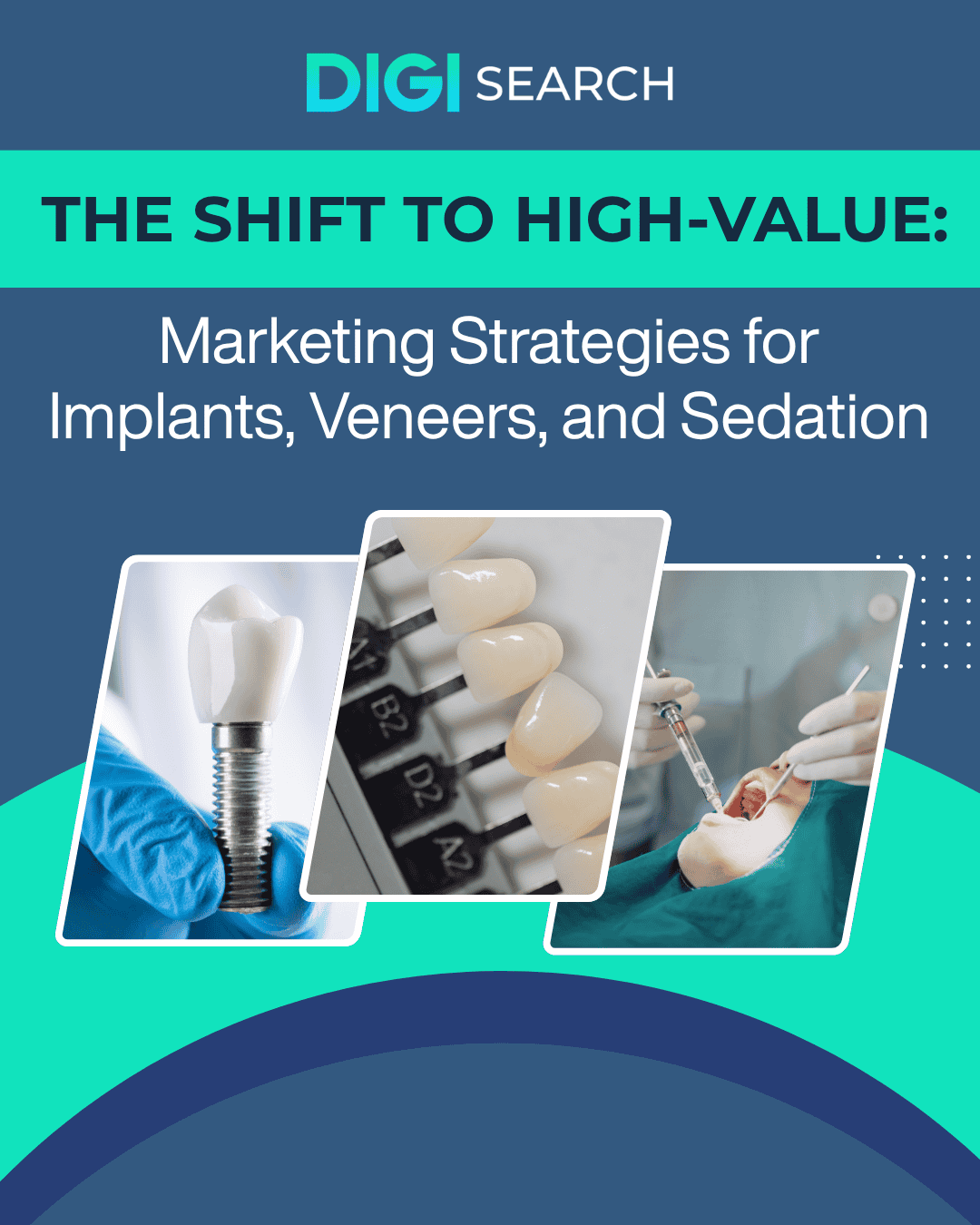
The same marketing strategy that fills the hygiene schedule does not fill the implant consult calendar.
That statement sounds obvious when laid out plainly. In practice, a large number of dental practices apply the same advertising approach to implants, full-arch restorations, porcelain veneers, and sedation dentistry that they use for cleanings and exams. They run a general dentistry ad, point traffic to a homepage or a generic services page, and then wonder why the high-value case volume is not moving.
The economics of high-value dental procedures require a fundamentally different marketing approach, and the practices that understand this distinction are pulling further ahead of those that do not.
Why High-Value Procedures Are Different
High-value dental procedures involve longer patient decision cycles than routine care. A patient considering a cleaning might book within days of a reminder. A patient considering full-arch dental implants may research, compare, and evaluate for months before scheduling a consultation. The financial commitment is larger. The personal vulnerability is greater. The threshold for trust is higher.
These patients are also doing more comparative shopping than routine-care patients. They are reading reviews specifically for implants, not just for the practice in general. They are evaluating before-and-after photos. They are researching what the procedure involves, what recovery looks like, and whether they are a candidate. By the time they contact a practice, they have usually already narrowed their list.
Marketing that reaches these patients once, in one channel, at one point in that extended research journey does not capture them. Marketing that stays visible and credible across multiple touchpoints throughout the research and consideration phase has a far stronger conversion rate.
Building Awareness Before the Search Begins
For high-value procedures, awareness marketing accomplishes more than name recognition. When a prospective patient sees a practice’s implant-focused content on a connected television screen at home, they encounter not just the practice’s name but evidence of its expertise and patient results. A well-produced video showing a real patient’s implant experience, delivered through NextGen TV™, tells a more complete story than a text-based search ad can communicate.
Awareness at this stage performs pre-qualification work. Prospective patients who respond favorably to that content arrive later in the funnel already oriented toward the practice. They are not comparing equal unknowns. They are confirming a preference formed earlier in the process.
NextGen TV™, which delivers streaming video ads to home television screens, is particularly well-suited for high-value procedure marketing. The format is immersive. The placement is premium. The targeting can be focused on the household income demographics and geographic areas that align with elective and restorative procedure case volume. A practice marketing all-on-four or full-arch restorations is not speaking to the same audience as a practice running a general awareness campaign, and the channel strategy should reflect that difference.
Staying Credible Through the Research Phase
Once a prospective patient enters active research mode, searching for “dental implants near me” or “best cosmetic dentist in [city],” the practice needs to be present and credible in multiple ways simultaneously.
Organic search visibility through SEO and GEO (Generative Engine Optimization) is foundational. A practice without strong rankings for relevant procedure keywords will not appear in front of patients who are actively looking. Content that answers the specific questions high-value patients ask, including candidacy criteria, procedure stages, recovery timelines, financing options, and expected outcomes, builds credibility at precisely the moment patients are forming their preferences.
This is where clinical content accuracy becomes a competitive differentiator. High-value procedure pages that use correct terminology, answer real patient questions with specificity, and reflect the actual clinical process perform better in search and convert better with the patients who find them. Generic content that could apply to any dental practice does not build the trust these patients are seeking. DIGI Search partners with a dental-specialized content writing partner, to produce procedure-specific content at this level of precision.
Reviews matter equally in the research phase, and specifically: reviews that mention the procedure the patient is considering. A practice with a strong recent review profile for implant cases specifically, not just for the practice in general, gives prospective patients social proof that is directly relevant to the decision at hand.
Converting Research Into Consultations
A prospective patient who has seen the practice’s NextGen TV™ content, found the website through search, read procedure-specific pages, and reviewed relevant patient testimonials has done significant pre-qualification before making first contact. The conversion step should feel like confirmation, not a cold introduction.
Verified Ads™ serves high-value patient acquisition well at this stage. Practices running Verified Ads™ appear at the very top of Google search results with verified trust signals built into the listing itself. For a patient about to commit to a significant case, that visible endorsement matters. It removes residual uncertainty about the practice’s credentials at the exact moment the patient is deciding whether to reach out.
Verified Ads™ is also cost-efficient for practices in competitive high-value markets. The economic model rewards qualified patient contact rather than browsing-stage clicks, which keeps spend focused on prospective patients with real intent.
What a Complete High-Value Strategy Looks Like Inside SmartReach™
Within the SmartReach™ methodology, high-value procedure marketing works as a coordinated, multi-stage system.
NextGen TV™ builds awareness at home among the right audience demographic. Retargeting stays present throughout the research phase as prospective patients compare practices online. SEO and GEO capture active search queries for high-value procedures. Verified Ads™ captures high-intent bottom-of-funnel searches with a credibility advantage. Procedure-specific content, for clinical accuracy and depth, converts research-phase interest into consultation requests.
At each stage, the practice is not trying to close a transaction. It is building the case for itself as the right choice. By the time a prospective patient calls or submits a form, the decision is largely made. The consultation confirms what the patient has already concluded.
That is the Educated Buyer: a patient who arrives informed, trusting, and ready to move forward. For high-value procedures, where the financial and personal stakes are elevated on both sides, this kind of pre-built trust produces consultation show rates and case acceptance rates that volume-driven, single-channel approaches cannot replicate.
Where to Start
For dental practices looking to improve high-value procedure marketing, the diagnostic questions are practical. What does current procedure-specific content look like? Does it answer the questions that patients researching implants or cosmetic treatment are actually asking? Is the practice visible in search for the specific procedure terms that drive consultation volume? Is there a retargeting strategy in place to stay present after a prospective patient visits the site but does not immediately reach out?
A DIGI Search discovery conversation starts with exactly these questions. The goal is to understand where gaps exist before recommending any specific investment.
Schedule a discovery call to explore a high-value patient acquisition strategy built around the practice’s specific case mix and goals.