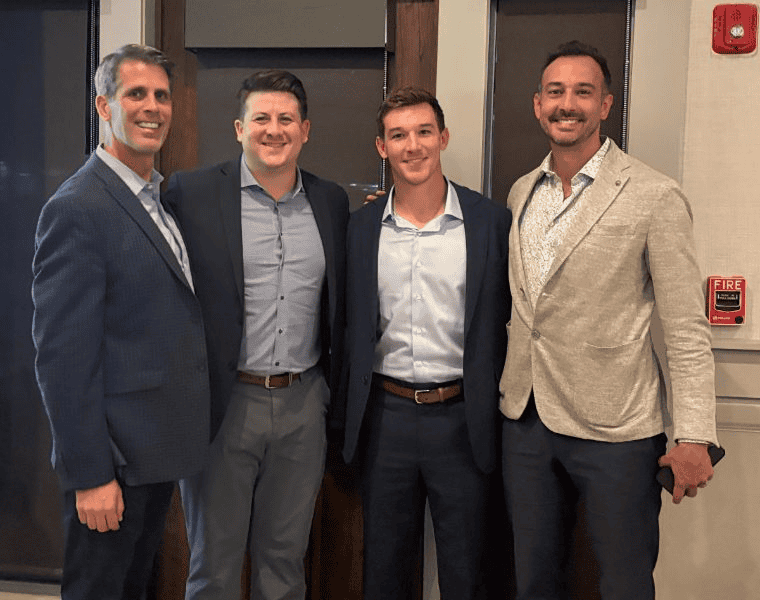
Four experts came together around a single question: what does a dentist need to know in order to sell a practice with confidence?
The idea started back in May, and the answer we kept returning to shaped the whole evening. The best time to prepare a practice for sale is now, while the dentist is still building it. So we set out to send every dentist home prepared, with their questions answered and a clear view of the steps ahead.
We called the evening Building a Practice Worth Selling, and we hosted it at Maggiano’s in Oak Brook. Our team arrived early to set up, and dinner started around 6:15. Once everyone was seated and settled in, the four speakers began their presentations one after another.
Matt Martin, Lakefront Advisors: A Prepared Practice Sells, and An Unprepared One Waits.
Matt opened on the gap between a dentist who prepares to sell and one who does not. His point was that the most expensive mistake is not selling too late, but waiting too long to prepare, because a practice can recover from a slow month or a bad hire and yet rarely recovers from three years of neglect right before a sale. Preparation, in his telling, is not a last-minute scramble but an ongoing investment that a dentist makes in staff, in bringing on an associate, and in steadily growing the patient base.
He made the contrast vivid with two dentists heading toward the same finish line. One decides to retire only after burning out, then cuts hours, stops investing, and lets the marketing lapse, assuming a buyer will understand. The other picks a target retirement date three to five years out and keeps the practice moving, maintaining the schedule, modernizing, and continuing to attract patients. Both doctors retire, but the one who planned leaves with more money and more options.
Matt also reframed what a buyer is really purchasing, which is not the practice itself but its future cash flow, its predictability, its low risk, and its room to grow. Everything a dentist does to prepare, from protecting hygiene to reducing how much the practice leans on the owner, supports those four things. As he put it, buyers do not pay for potential, they pay for proof.
Owen Williams, Williams Dental Consulting: Find the Leaks Before a Buyer Does.
Owen started with the reality of practice ownership, which is that one person is often the clinician, the business owner, the team leader, and the marketer all at once, and systems tend to slip in the gaps. That, he said, is why most practices run like a leaky bucket, quietly losing revenue and trust through weak spots in a department or a process.
The leaks that matter most for a sale are the ones tied to how a practice keeps and grows its patients: recare and retention, collections, the way treatment is presented and followed up, and the absence of any real system for internal referrals and reviews. His advice was not to fix everything at once, but to identify the leaks and close them one at a time. Referrals and reviews matter even more at sale time, because they are visible proof that a practice runs well.
Owen was also candid about why good systems so often fail to stick, which comes down to inconsistent accountability and follow-through rather than bad intentions. Williams Dental Consulting works through a steady loop of diagnosing, designing, training, and refining so that new systems actually hold. When they do, he showed, both production and new patient numbers climb, and the dentist can hand over a practice they are proud of.
Chris Brown, DIGI Search: Patients Rarely Choose a Dentist in a Straight Line.
Our founder, Chris Brown, picked up the thread on marketing and the journey a patient actually travels before booking. Patients now research on their phones across more platforms than ever, looping between their options until one practice feels like the safe choice, and by the time they call, most have already made up their minds. Chris called that looping stretch of research and comparison the Messy Middle.
Winning that middle, he explained, comes down to three things: showing up before the need so your name is already familiar, being easy to find and easy to trust across search, maps, AI answers, and reviews, and making it effortless to book once a patient is ready. The SmartReach™ funnel is the system DIGI Search uses to do exactly that, meeting patients at each stage from the first impression all the way to a booked appointment.
Chris also tied the night together with a single number. Banks and buyers value a practice on its new patients per month, so the same marketing that fills the schedule today is what builds the practice’s value for a future sale. He closed on the idea at the heart of how we work, which is that a dentist should choose a partner, not a vendor. A real partner keeps the ad accounts, the website, and the phone numbers in the practice’s name, reports on booked patients and production rather than clicks and impressions, and earns the relationship every month instead of hiding behind activity it never proves.
Chad Kaup, Bank of America Practice Solutions: The Bank Sees the Sale From the Other Side of the Table.
Chad brought the view from the financing side, where he has helped many dentists buy and sell. He walked through the real difference between a private sale and a corporate one. A private sale often means selling to an associate, with the flexibility to structure a buy-in over time, while a corporate sale usually means a DSO or group practice with a more fixed structure. His practical takeaway was that the time to line up and pre-qualify a potential buyer is now, not at the finish line.
He also laid out what it takes to be ready when the deal reaches the table. That means not coasting through the final years, keeping the books clean enough for an outside buyer to trust, investing with resale value in mind, and getting a real appraisal of what the practice is worth. He encouraged every owner to assemble a team early, including a financial advisor, a practice broker, an attorney, and an accountant, so that no part of the sale becomes a scramble.
Underneath the mechanics, Chad kept returning to two questions that have nothing to do with spreadsheets. What do you want your retirement to look like, and what do you want your legacy to be? For most of the dentists in the room, those were the questions that made the rest of the evening matter.
The Conversation Kept Going After the Last Talk.
When the presentations wrapped and dinner wound down, people stayed. They talked, traded questions, and kept the conversation going, and that was exactly the night we had hoped for. One dentist reached out afterward to thank us and told us they learned a lot. That is why we built the evening in the first place. A practice worth selling is a practice worth building, and the dentists in the room left with a clearer plan to do both.
You can view photos from the night here.
If anything the speakers covered struck a chord, we would love to keep the conversation going. You can schedule a call with our team here. And this will not be the last evening of its kind, so keep an eye out for our next one!